What is IRS Form 720?
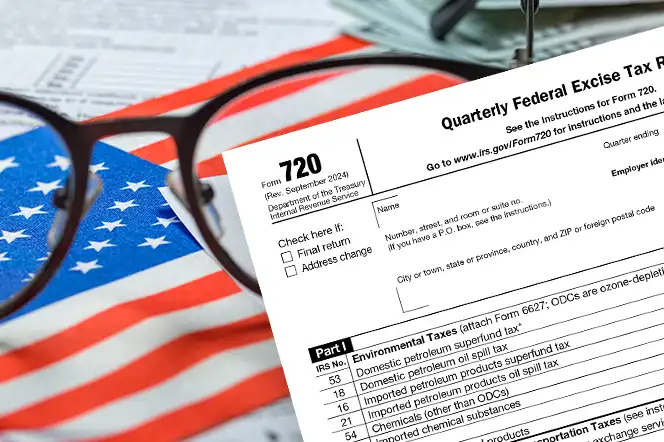
IRS Form 720 is the Quarterly Federal Excise Tax Return used to report and pay certain federal excise taxes. Most Americans abroad do not need to file it. However, US expats involved in specific business activities, self-insured health plans, or other excise-tax-related transactions may still have filing obligations.
The table below provides a quick overview of the most important facts about IRS Form 720.

Rose-ann De Villa, an IRS Enrolled Agent and CPA with 15 years of expat tax experience, specializes in US tax preparation, tax planning, and tax advice for US citizens and Green Card holders living and working in the UK.
Rose-ann has been mentioned in the Daily Express UK news wherein she talked about Stimulus payments and Child Tax Credit refunds for US expats in the UK. *Schedule a consultation with Rose-ann today.
*30-minutes US$347.
Table of Contents
IRS Form 720 at a glance
|
Question |
Answer |
|
What is IRS Form 720? |
Quarterly Federal Excise Tax Return |
|
Who files it? |
Taxpayers responsible for certain federal excise taxes |
|
How often is it filed? |
Quarterly |
|
Can it be filed from overseas? |
Yes |
|
Can it be e-filed? |
Yes, through approved providers, although paper filing is still accepted. |
|
What happens if you file late? |
Penalties and interest may apply |
Do Americans abroad need IRS Form 720?
No. Most Americans abroad do not need to file IRS Form 720. For many expats, this is the most valuable takeaway from the entire article.
If you are working overseas as an employee, receiving pension income, holding foreign bank accounts, owning foreign investments, or filing a standard US tax return, Form 720 usually does not apply.
However, there are exceptions. Certain business owners and taxpayers involved in specific activities may still have filing obligations even while living outside the United States.
The examples below illustrate when IRS Form 720 may become relevant for Americans living abroad.
Situations where US expats may need IRS Form 720
|
Situation |
May need Form 720? |
|
Employee living abroad |
Usually no |
|
Retiree living abroad |
Usually no |
|
US LLC owner abroad with excise-tax activity |
Possibly |
|
Business involved in certain excise-tax activities |
Often yes |
|
Sponsor of a self-insured health plan subject to PCORI fees |
Often yes |
|
Investor with no excise-tax activities |
Usually no |
Common misconception: Owning a US LLC or business abroad does not automatically mean you must file Form 720. The filing requirement depends on the activity that generates the excise tax obligation.
How do you complete IRS Form 720?
To complete IRS Form 720, identify the applicable excise taxes, calculate any tax due, complete the relevant sections of the return, and submit payment if required.
A typical filing process looks like this:
Step 1: Gather your records
Collect documentation related to the activity generating the excise tax liability.
Step 2: Determine which taxes apply
Not every excise tax applies to every taxpayer. Review the IRS instructions carefully to identify the relevant category. Examples of taxes commonly reported on Form 720 include:
- Fuel taxes
- Air transportation taxes
- Indoor tanning services taxes
- Environmental taxes
- Certain foreign insurance and reinsurance taxes
- Patient-Centered Outcomes Research Institute (PCORI) fees
Step 3: Complete the applicable sections
Form 720 contains multiple reporting sections depending on the type of excise tax involved.
Step 4: Calculate your liability
Determine the amount of tax owed based on the applicable rates and reporting rules.
Step 5: Review the return
A second review can help catch reporting errors before submission.
Step 6: File the return and pay any tax due
Submit the form using a filing method accepted by the IRS and make any required payment or deposits by the applicable deadline.
Where do you file IRS Form 720?
IRS Form 720 can generally be filed electronically through an authorized provider or submitted by mail, according to the current IRS filing instructions.
Many taxpayers now choose electronic filing because it provides faster confirmation and reduces mailing delays. If filing by mail, always verify the most recent filing address before sending the return. IRS mailing addresses occasionally change, and outdated information can delay processing.

Need more help navigating excise taxes?
Connect with our experts today.
When is IRS Form 720 due?
IRS Form 720 is generally due by the last day of the month following the end of each calendar quarter. For example, returns covering 2025 activity were due on:
- April 30, 2025 (Q1)
- July 31, 2025 (Q2)
- October 31, 2025 (Q3)
- February 2, 2026 (Q4)
Important: Q4 Form 720 returns are normally due on January 31 of the following year. For 2025 activity, the deadline moved to February 2, 2026 because January 31, 2026 fell on a Saturday. When a due date falls on a weekend or legal holiday, the IRS generally allows filing on the next business day.
What happens if you do not file IRS Form 720?
Failing to file IRS Form 720 can result in penalties, interest charges, and additional IRS correspondence if tax is owed.
The IRS expects taxpayers to file required returns on time, regardless of where they live. If a filing obligation exists and the return is not submitted, the consequences may include:
- Failure-to-file penalties
- Failure-to-pay penalties
- Interest on unpaid tax
- IRS notices requesting additional information
- Collection activity in more serious situations
Expat tip: Many Americans abroad assume that living overseas automatically provides extra filing flexibility. While expats often receive additional time for certain income tax filings, excise tax obligations generally follow their own deadlines and requirements.
What happens if you file IRS Form 720 late?
Filing IRS Form 720 late may result in penalties, interest charges, and additional costs if tax is owed. The exact amount depends on several factors, including:
- How late the return is filed
- Whether tax was owed
- Whether payment was made on time
- Whether the taxpayer qualifies for penalty relief
What are the most common IRS Form 720 mistakes?
Common IRS Form 720 mistakes include filing late, reporting the wrong excise tax, miscalculating tax due, and failing to submit payment on time. A few mistakes appear repeatedly:
1. Assuming the form applies to every business owner
Many expats discover Form 720 while researching US business taxes and immediately assume they must file it. Often, they don’t.
2. Missing quarterly deadlines
Unlike annual income tax returns, Form 720 generally follows a quarterly filing schedule.
3. Using outdated instructions
Excise tax rules change periodically. Using an older version of the instructions can create reporting errors.
4. Ignoring IRS notices
Even minor correspondence should be reviewed carefully. Small issues are often easier to fix before they grow into larger ones.
Frequently Asked Questions
Can IRS Form 720 be e-filed?
Yes. IRS Form 720 can generally be filed electronically through IRS-authorized e-file providers.
Does IRS Form 720 require a wet signature?
Generally, a wet signature is not required when Form 720 is filed electronically. If you file a paper return, the form must be signed before submission. Electronic signature requirements may vary depending on the IRS e-file process and the authorized e-file provider used.
Can you have a Form 720 filing requirement without living in the US?
Yes. A taxpayer’s location does not automatically determine whether Form 720 applies. The underlying activity creating the excise tax obligation is usually what matters.
Is IRS Form 720 the same as Form 2290?
No. Form 720 reports various federal excise taxes, while Form 2290 is used specifically for the Heavy Highway Vehicle Use Tax on certain vehicles.
Do I need to file IRS Form 720 if I had no excise tax activity?
Generally, no. However, if you previously filed Form 720 and have not filed a final return, you may still need to file a zero or final return depending on your situation.