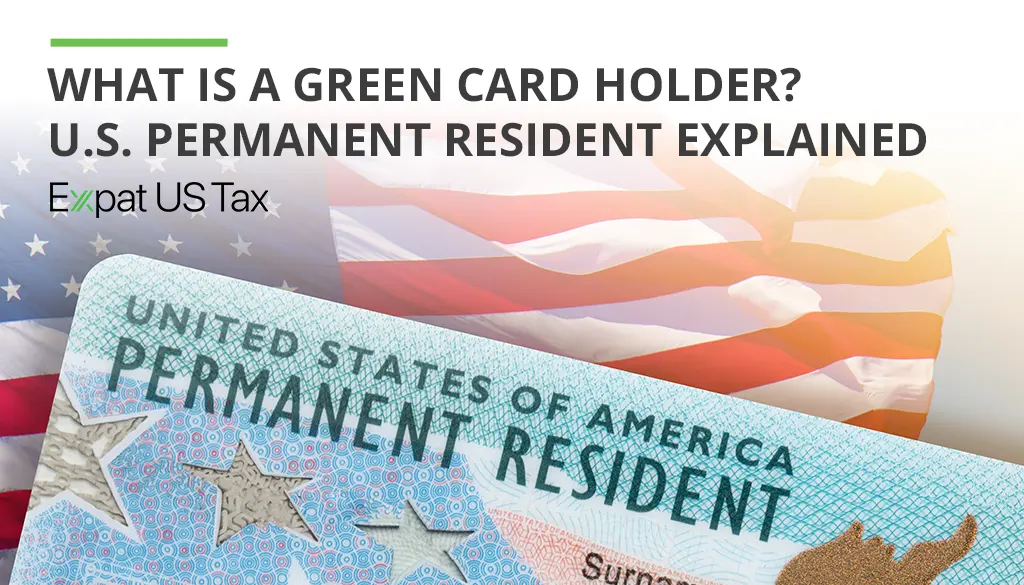
What is a Green Card Holder?
A Green Card holder is a lawful permanent resident (LPR) of the United States. You can live and work in the US indefinitely, carry a Green Card as proof of status, and re-enter the country after trips abroad (subject to routine entry rules).

Aya Takriti, an IRS Enrolled Agent with 12 years of expat tax experience, specializes in US tax preparation, tax planning and tax advice for US citizens and Green Card holders living and working in the Middle East. *Schedule a consultation with Aya today.
*30-minutes US$247.
Table of Contents
What can you do as a permanent resident right now?
- Work: Take most jobs without a separate work permit. Some federal roles and positions that need certain clearances are citizens-only.
- Live in the US: Move between states, rent or buy a home, enroll in school, qualify for in-state tuition where rules allow.
- Build a life: Open bank accounts, get a driver’s license, start a business, and sponsor certain family members for residence.
What are the limits you should keep in mind?
- No federal voting: You cannot vote in federal elections. Some local allowances exist in a few places, but treat federal voting as off-limits.
- Passport: You do not get a US passport until you naturalize. You travel with your foreign passport plus your Green Card.
- Benefits: Some federal benefits are available after a waiting period and subject to eligibility rules. Check specific programs rather than assuming yes or no.
- Criminal and fraud risks: Certain convictions or immigration fraud can trigger proceedings to take away LPR status.
What if the card is lost or expired?
The status continues even if the card expires or is lost. You should still replace the card so you can prove your status and travel easily. Use Form I-90 to renew or replace the card, and keep your address updated with USCIS within 10 days of moving.
Can a Green Card be “conditional”?
Yes. Marriage-based residents often get a 2-year conditional Green Card if the marriage was under two years old when approved. You must file to remove conditions on time or your status can lapse. Children who received conditional status generally follow the same timeline.
Which family members can you sponsor as an LPR?
You can sponsor a spouse and unmarried children. Wait times vary by category and home country.
How is a Green Card holder different from a US citizen?
A Green Card holder is a permanent resident, not a US citizen, which means they can live and work in the United States indefinitely but do not have full civic rights like voting or holding a US passport.
Can a Green Card holder vote or hold a US passport?
- Voting: You cannot vote in federal elections. Some local elections have special rules, but don’t assume you can vote.
- Passport: Only citizens get a US passport. As an LPR you use your foreign passport plus your Green Card to enter the US.
What jobs and benefits are different?
- Jobs: Many federal positions and roles requiring particular clearances are citizens-only. Most private-sector roles are open to LPRs.
- Benefits: Access exists for some programs after a residency period and income checks. Each program has its own rules, so read the fine print.
What are your ongoing responsibilities as an LPR?
- Taxes: File US tax returns as a resident unless you’ve formally given up LPR status.
- Selective Service: Males 18-25 generally must register.
- Address changes: Notify USCIS of a new address within 10 days.
- Carry proof: Keep the card on you or accessible; it’s your evidence of status.
How does the path to citizenship (naturalization) work?
- Time as an LPR: Usually 5 years. It’s 3 years if you’re married to and living with a US citizen for that whole time.
- Physical presence: For the 5-year route, aim for 30 months physically in the US; for the 3-year route, 18 months.
- Continuous residence: Trips over 6 months can disrupt the clock; over 12 months usually break it unless you have special protections.
- Other boxes: Good moral character, English and civics tests, and proper filing. Keep passports and travel logs to document every absence.

Have a green card and US tax concerns? Contact us today for guidance.
Do Green Card holders pay US taxes on worldwide income?
Yes. If you’re a Green Card holder (lawful permanent resident), you’re treated as a US tax resident and you generally report worldwide income on Form 1040 each year, even if you live or work abroad.
What counts as “worldwide income”?
Wages and bonuses, self-employment income, rental profits, interest, dividends, capital gains, pensions, annuities, and most other earnings from inside or outside the US.
How do you avoid being taxed twice?
You usually start with the Foreign Tax Credit (Form 1116) to claim income taxes you paid to another country. Some people also look at tax treaties, but using a treaty to claim nonresident status can create immigration problems, so it’s best to get advice before you do that. The Foreign Earned Income Exclusion (Form 2555) may help if you qualify, but you will want to compare it against the Foreign Tax Credit first.
Do bank and investment accounts abroad trigger extra forms?
More often than not, yes. File an FBAR if your combined foreign accounts exceeded US$10,000 at any time in the year. File Form 8938 if your specified foreign assets pass the threshold for your filing status and where you live. These are separate from your tax return.
How long can a Green Card holder stay outside the US without losing status?
Short trips are fine. Long or frequent absences can raise “abandonment” concerns and can also disrupt your timeline for citizenship.
What’s generally safe vs risky?
- Under 6 months: Usually fine if the trip is clearly temporary.
- 6 to 12 months: Expect more questions on return. Bring proof of US ties such as a lease, job letter, recent utility bills, or your latest US tax return. For naturalization, trips over 6 months can break continuous residence unless you have a narrow protection.
- 12 months or more: High risk without planning. Apply for a reentry permit before you leave if you expect an extended stay.
How do reentry permits work for Green Card holders?
Apply while you’re physically in the US. A reentry permit is typically valid for up to two years and helps you reenter after long trips. It does not preserve the physical-presence or continuous-residence counts you need for citizenship.
If you’re already abroad over a year without one, you may need a returning resident (SB-1) visa at a US consulate, which isn’t guaranteed.
What travel patterns trigger red flags?
Back-to-back long absences, giving up your US home and job while living abroad, filing as a nonresident for US tax purposes, or keeping only minimal US ties.
How do I renew a Green Card?
For a standard 10-year Green Card, file Form I-90 about 6 months before it expires. Use I-90 as well if the card is lost, stolen, damaged, or your name or details changed and you need a replacement.
I’m a conditional resident. Do I still file I-90?
No. If your card is the 2-year conditional type, file Form I-751 (marriage) or Form I-829 (investor) during the 90 days before the card expires. Use I-90 only to replace a still-valid conditional card with the same info.
How do I file I-90?
Create a USCIS online account or mail the paper form. Upload copies of your current card and any supporting documents, pay the fees, and watch your case status online. If USCIS schedules biometrics, show up with your notice and ID.
Can I work and travel while renewal is pending?
Usually, yes. Your I-90 receipt notice extends your status for a set period. For work or I-9 updates, present the expired card plus the receipt. For travel, carry your passport, your card, and the receipt. If an airline or officer needs stronger proof, book an appointment for an I-551 (ADIT) stamp in your passport.
What if I’m a US expat renewing from overseas?
Plan for biometrics in the US. If your card is lost or expired while you’re abroad, a US consulate can issue a boarding foil after you file Form I-131A, so you can fly back and finish the process.
What documents should I keep handy?
- Front and back of your current or expired Green Card
- Passport ID page and any recent US entry stamps
- Name-change or identity records (marriage certificate, court order)
- I-90 receipt notice, biometrics letter, and any appointment emails
- Proof of US address and a way to receive mail securely
FAQs
Can a Green Card holder use the Foreign Earned Income Exclusion (FEIE)?
Yes, LPRs can use FEIE if they meet the physical-presence or bona-fide-residence test. FEIE doesn’t by itself risk your status; claiming treaty nonresident status can.
Can a Green Card holder sponsor parents or married children?
Do I need a visa to reenter the US if I have a Green Card?
Do Green Card holders living abroad still have to file a state tax return?
If my child is born outside the US and I’m a Green Card holder, is the child a US citizen?