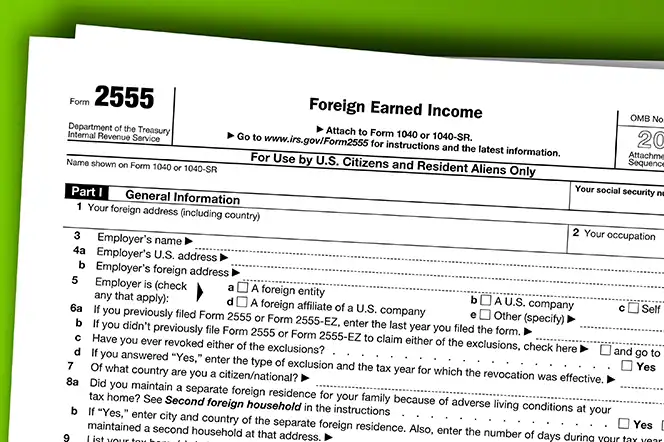
What is Form 2555?
Form 2555, officially titled Foreign Earned Income, is the IRS form that eligible US citizens and resident aliens may use to claim the Foreign Earned Income Exclusion (FEIE) and, if eligible, the Foreign Housing Exclusion or Foreign Housing
If you’re an American living in Australia or another country, you generally still need to file a US tax return each year. Before deciding whether to file Form 2555, it’s helpful to understand who can use it, what tax benefits it provides, and where its limits are.

Jonathan Rose, an IRS Enrolled Agent with 15 years of expat tax experience, specializes in US tax preparation, tax planning, and tax advice for US citizens and Green Card holders living and working in Australia.
Jonathan also talked about family tax benefits in Australia. Schedule a consultation with Jonathan today*.
*30-minutes US$347.
Table of Contents
Do I qualify for Form 2555?
To qualify for Form 2555, the IRS uses these rules to determine whether you’re eligible to claim the Foreign Earned Income Exclusion (FEIE).
- Have a tax home in a foreign country. Your tax home is generally your main place of work, not your permanent home. To qualify, your tax home must generally be outside the United States.
- Meet one of the IRS qualifying tests. You only need to meet one of these tests, not both.
- Physical Presence Test. You’re physically present in one or more foreign countries for at least 330 full days within any 12 months.
- Bona Fide Residence Test. You’re a bona fide resident of a foreign country for an uninterrupted period that includes an entire tax year.
You generally won’t qualify if you: - Only receive passive income, such as interest, dividends, capital gains, or pension income.
- Earn all of your income from work performed in the United States.
- Don’t meet the tax home or residency requirements.
Important: Most US citizens can qualify under either test if they meet the requirements. Resident aliens generally have additional eligibility rules for the Bona Fide Residence Test.
What income can I exclude with Form 2555?
Form 2555 only applies to foreign earned income. It doesn’t apply to passive income or income earned from work performed in the United States.
Types of income that qualify for the Foreign Earned Income Exclusion:
- Wages and salary
- Bonuses and commissions
- Self-employment income
- Professional fees
- Tips
- Taxable allowances related to your employment
Types of income that generally don’t qualify:
- Interest income
- Dividend income
- Capital gains
- Pension and annuity income
- Social Security benefits
- Rental income, unless it’s received as payment for services you provide
- Pay received as an employee of the US government or one of its agencies.
Example: If you’re an American living and working in Australia, your salary from an Australian employer may qualify as foreign earned income. However, if you travel back to the United States and perform work while you’re there, the income earned on those days generally isn’t considered foreign earned income.

Living abroad? Form 2555 may help reduce your US tax bill.
How much foreign income can I exclude?
The maximum Foreign Earned Income Exclusion (FEIE) is adjusted annually for inflation.
Foreign Earned Income Exclusion (FEIE) limits by tax year
|
Tax year |
Maximum FEIE |
|
2025 |
US$130,000 |
|
2026 |
US$132,900 |
The maximum exclusion applies per qualifying person. If you don’t qualify for the entire tax year, your exclusion is generally prorated based on your qualifying period.
You may also be able to claim one of the following housing benefits if you have eligible foreign housing expenses:
- Foreign Housing Exclusion: Generally applies to eligible housing expenses paid from employer-provided amounts, including taxable salary and employer-paid allowances.
- Foreign Housing Deduction: Generally applies to eligible housing expenses paid from self-employment earnings.
The amount you can claim depends on where you live, your eligible housing expenses, and the IRS housing limits for your location.
How do I file Form 2555?
Form 2555 is filed with your annual US federal income tax return (Form 1040). It can’t be filed separately.
When completing Form 2555, you’ll report your foreign tax home, the qualifying test you meet, your foreign earned income, and any eligible housing expenses if you’re claiming a housing benefit.
Before you file: Make sure you have records that support your claim, such as:
- Employment contracts or payslips
- Foreign tax documents
- Detailed travel records showing the dates you entered and left each country, including time spent in the United States or travelling between countries.
- Proof of foreign residency, such as a visa or residency permit
- Records of eligible housing expenses, if applicable
You don’t need to submit these documents with your return, but you should keep them in case the IRS asks for additional information.
When is Form 2555 due? Form 2555 is due when you file your federal income tax return.
If you qualify for the automatic two-month overseas extension, you can generally file your return and pay the tax due by June 15. However, interest is charged on any unpaid tax from the regular April filing deadline. You must also attach a statement explaining that you qualify for the overseas extension.
If you need more time to file, you can generally extend the filing deadline until October 15 by submitting Form 4868 by your applicable filing deadline. This extension does not extend the time for interest to begin accruing on unpaid tax.
Should I use Form 2555 or Form 1116?
It depends on your tax situation. Form 2555 excludes qualifying foreign earned income, while Form 1116 provides a credit for foreign income taxes you’ve already paid.
Many US expats qualify for both, but they work differently and aren’t always interchangeable.
Form 2555 vs. Form 1116
|
Feature |
Form 2555 |
Form 1116 |
|
Primary benefit |
Excludes foreign earned income |
Claims a credit for foreign income taxes paid |
|
Commonly considered when |
The taxpayer qualifies and pays little or no foreign income tax, or the exclusion otherwise produces a better overall result |
The taxpayer has paid foreign income tax and wants to offset US tax while keeping the income included on the US return |
|
Covers passive income |
No |
Yes, in some cases |
|
Can reduce self-employment tax |
No |
No |
You generally can’t claim both benefits on the same income. If you exclude income using Form 2555, you can’t also claim a Foreign Tax Credit on that excluded income.
What mistakes should I avoid?
Small mistakes on Form 2555 can reduce your tax benefits or delay the processing of your return.
Some of the most common mistakes include:
- Claiming the exclusion without meeting the eligibility requirements. You must have qualifying foreign earned income, have a tax home in a foreign country, and meet either the Physical Presence Test or the Bona Fide Residence Test.
- Including income that doesn’t qualify. Passive income, such as interest, dividends, pensions, and capital gains, generally can’t be excluded.
- Claiming the exclusion on income earned in the United States. The exclusion only applies to income from services performed in a foreign country.
- Forgetting to prorate the exclusion. If you don’t qualify for the entire tax year, your maximum exclusion is generally reduced.
- Keeping incomplete records. Travel records, employment documents, and proof of foreign residency can help support your claim if the IRS requests additional information.
- Assuming Form 2555 reduces self-employment tax. The Foreign Earned Income Exclusion may reduce federal income tax, but it does not ordinarily reduce US self-employment tax.
Frequently Asked Questions
Can I file Form 2555 electronically?
Yes. Most major tax software and professional tax preparers support electronic filing of Form 2555 when it’s submitted with your Form 1040. If you’re filing by mail, attach Form 2555 to your federal tax return before sending it to the IRS.
Do I need to file Form 2555 every year?
Yes, if you want to claim the Foreign Earned Income Exclusion for that tax year and you meet the eligibility requirements. The exclusion isn’t automatic, so you’ll generally need to file Form 2555 each year you claim it.
Can I revoke the Foreign Earned Income Exclusion?
Yes. You can choose to revoke the Foreign Earned Income Exclusion. However, once you revoke it, IRS rules generally prevent you from claiming it again for five tax years unless you receive IRS approval to re-elect it. Because of this restriction, it’s worth considering the long-term tax impact before revoking the exclusion.
Can I add Form 2555 after I’ve already filed my tax return?
Yes, in some cases. If you forgot to include Form 2555 with your original return, you may be able to add it by filing an amended return, provided you meet the IRS election rules and deadlines. The IRS also permits certain late elections if you qualify.
Does Form 2555 affect my eligibility for the Child Tax Credit?
Yes. If you file Form 2555, you cannot claim the refundable Additional Child Tax Credit for that tax year. You may still qualify for the nonrefundable Child Tax Credit, depending on your tax liability and whether you meet the other eligibility requirements. This is one reason to compare Form 2555 with the Foreign Tax Credit before deciding which approach to use.