Form 1116 explained for US expats (2025 foreign tax credit guide)
Form 1116 is the IRS form used to claim the Foreign Tax Credit, helping Americans abroad reduce double taxation on foreign income. US expats commonly file Form 1116 to claim credits for income taxes paid to countries such as the UK, Australia, Canada, and France.

Jonathan Rose, an IRS Enrolled Agent with 15 years of expat tax experience, specializes in US tax preparation, tax planning, and tax advice for US citizens and Green Card holders living and working in Australia.
Jonathan also talked about family tax benefits in Australia. Schedule a consultation with Jonathan today*.
*30-minutes US$347.
Table of Contents
Key Takeaways:
- Form 1116 is used to claim the Foreign Tax Credit.
- Form 1116 is commonly used by US citizens and Green Card holders living abroad.
- Many expats need Form 1116 once foreign taxes exceed the IRS simplified election thresholds.
- Unused Foreign Tax Credits may generally carry back 1 year and forward 10 years.
- Form 1116 does not usually reduce the US self-employment tax.
- Form 1116 and Form 2555 generally cannot apply to the same excluded income.
What is Form 1116 used for?
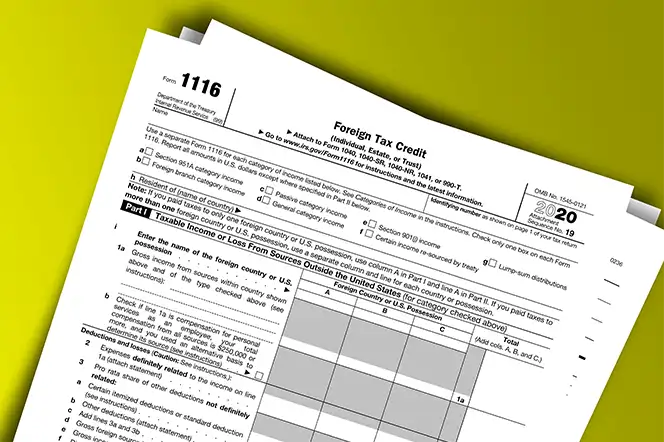
Form 1116 is used to claim the Foreign Tax Credit, allowing taxpayers to apply qualifying foreign income taxes against their US income tax liability.
The form is attached to a US tax return to calculate the amount of foreign tax credit the IRS allows. Unlike Form 2555, which excludes qualifying earned income, Form 1116 works through a credit system.
Common situations where Form 1116 applies
|
Situation |
Form 1116 usually applies |
|
UK salary taxed through PAYE |
Yes |
|
Australian employment income |
Yes |
|
Foreign dividend withholding taxes |
Usually |
|
Foreign rental income taxes |
Often |
|
Only foreign bank accounts |
No |
|
Using only the Form 2555 exclusion |
Sometimes, but not always |
What is Form 1116 for US citizens living abroad?
Many Americans overseas encounter Form 1116 after discovering they may still need to file US tax returns even while paying taxes locally abroad.
The US taxes citizens on worldwide income regardless of residence. That means some taxpayers end up reporting income to both the IRS and another country during the same year.
This commonly affects:
- employees working abroad,
- remote workers,
- freelancers,
- retirees receiving foreign pensions,
- and taxpayers with overseas investments.
The form appears frequently in countries with established income tax systems, including:
- the UK,
- Australia,
- Canada,
- Germany,
- and France.
For many long-term overseas filers, Form 1116 becomes part of ongoing annual reporting rather than a one-time filing issue.
Some taxpayers instead rely on Form 2555, which excludes qualifying earned income rather than applying a tax credit. The two approaches solve similar problems in different ways.
When is Form 1116 required?
Form 1116 is generally required if you paid or accrued foreign taxes and do not qualify for the IRS exception that allows certain taxpayers to claim the Foreign Tax Credit without filing the form. The exception is limited and usually applies only when the foreign income is passive income, the foreign taxes are US$300 or less (or US$600 for married couples filing jointly), and the income and taxes are reported on qualified payee statements.
The IRS allows certain taxpayers to claim a limited Foreign Tax Credit without filing Form 1116. However, the exception is fairly narrow.
Simplified Foreign Tax Credit thresholds
|
Filing status |
Simplified FTC threshold |
|
Single |
Up to US$300 foreign taxes |
|
Married filing jointly |
Up to US$600 foreign taxes |
The simplified election usually applies only when:
- The income is passive income,
- The taxes qualify under IRS rules,
- and the amounts are reported on a qualified payee statement, such as Form 1099-DIV.
Many taxpayers abroad exceed these thresholds relatively quickly because:
- Foreign income taxes withheld through payroll can be substantial,
- investment withholding taxes accumulate,
- and overseas income often falls into multiple categories.
Once that happens, Form 1116 is generally required to properly calculate the allowable credit.
When you may not need Form 1116
Some taxpayers may claim the Foreign Tax Credit without filing Form 1116 under the IRS simplified election.
This exception usually applies only when:
- Foreign income is passive income,
- qualified foreign taxes are US$300 or less, or US$600 for joint filers,
- and the taxes are reported on qualified payee statements, such as Form 1099-DIV or Form 1099-INT.
The exception commonly applies to small foreign dividend withholding taxes. However, many Americans abroad still need Form 1116 because foreign payroll taxes often exceed the thresholds, income falls into multiple categories, or the taxes are not reported on qualified payee statements.

Wondering if Form 1116 applies to you? Get in touch today for answers.
What are the eligibility requirements for the foreign tax credit Form 1116?
To claim the Foreign Tax Credit using Form 1116, the foreign tax generally must be imposed on you, legally owed, paid or accrued, and based on income.
Basic Form 1116 eligibility rules
|
Requirement |
Meaning |
|
Foreign tax imposed on you |
You must personally owe the tax |
|
Legal foreign tax liability |
The tax must be valid under foreign law |
|
Paid or accrued |
You paid it or became liable for it |
|
Income tax or tax in lieu of income tax |
The tax must generally relate to income |
Note: Not every foreign payment qualifies. For example, VAT, sales taxes, property taxes, and certain social taxes generally do not qualify.
The IRS also separates international income into categories, often called baskets. The two most common are:
- general category income
- passive category income
Form 1116 vs 2555: which is better for expats?
Form 1116 and Form 2555 reduce international tax overlap differently, so the better option depends heavily on income type, country of residence, and long-term tax planning.
Form 1116 vs Form 2555
|
Feature |
Form 1116 (Foreign Tax Credit) |
Form 2555 (Foreign Earned Income Exclusion) |
|
Uses foreign taxes paid |
Yes |
No |
|
Excludes earned income |
No |
Yes |
|
Works well in high-tax countries |
Usually |
Sometimes |
|
Can preserve Child Tax Credit eligibility |
Often |
Not always |
|
Applies to passive income |
Yes |
No |
|
Common for UK or Australian expats |
Often |
Depends |
For the 2025 tax year filed in 2026, eligible taxpayers may exclude up to US$130,000 of foreign earned income using Form 2555.
Many taxpayers already paying relatively high foreign income taxes lean toward Form 1116 because:
- Unused credits may carry forward,
- investment income can still qualify,
- and the credit may interact more favorably with other tax benefits.
Meanwhile, Form 2555 may still work well in lower-tax jurisdictions or situations where foreign taxes are relatively limited.
One important limitation remains: The same income generally cannot receive both the Foreign Earned Income Exclusion and the Foreign Tax Credit simultaneously. Foreign taxes tied to excluded income also generally cannot be used in the Form 1116 credit calculation.
Example: Form 1116 vs Form 2555 for a US expat in the UK
A US citizen living in London earns £90,000 and pays relatively high UK income taxes through PAYE. Here is a simplified comparison:
|
Strategy |
Possible outcome |
|
Form 2555 |
Excludes qualifying foreign earned income up to the annual IRS limit, but may reduce access to certain credits, and does not apply to investment income |
|
Form 1116 |
Claims UK income taxes as Foreign Tax Credits, which may fully offset US income tax while preserving unused credits for future years |
Key Takeaway: Many expats in higher-tax countries such as the UK, Australia, and Canada prefer Form 1116 because foreign taxes may already offset US income tax. Meanwhile, taxpayers in lower-tax countries may prefer Form 2555 to reduce their immediate US taxable income.
How does Form 1116 calculate the Foreign Tax Credit?
Form 1116 calculates the maximum Foreign Tax Credit allowed based on the portion of your taxable income that comes from foreign sources. The IRS does not automatically allow every dollar of foreign taxes paid to be treated as a full credit. Instead, Form 1116 applies a limitation formula.
Foreign Tax Credit limitation formula:
FTC Limit = US Tax Liability × (Foreign Source Taxable Income ÷ Worldwide Taxable Income)
In simpler terms, the IRS limits the credit to the portion of US tax tied to foreign-source income.
For many expats, this calculation works in their favor. However, taxpayers with large investment income, mixed income categories, foreign losses, or complicated sourcing rules can see more complicated results.
Unused credits may sometimes be carried back one year or carried forward for up to 10 years, depending on the situation. That carryover feature is one reason many higher-income expats prefer Form 1116 over relying solely on exclusions.
Step-by-step guide to completing Form 1116
Completing Form 1116 generally involves reporting foreign income, entering qualifying foreign taxes paid, separating income categories, and calculating the allowable Foreign Tax Credit.
Step 1: Gather overseas income records
Collect documentation for:
- salary,
- self-employment income,
- dividends,
- rental income,
- pensions,
- and investment earnings.
Step 2: Convert amounts into US dollars
Foreign income and taxes generally need to be converted into US dollars using the appropriate exchange rates.
Step 3: Separate income categories
Group income into the correct IRS categories before calculating the allowable credit.
Step 4: Calculate the allowable limitation
Form 1116 determines the maximum credit allowed under IRS limitation rules.
Step 5: Transfer the credit onto Form 1040
The allowable amount then offsets qualifying US income taxes on the return.
Example of Form 1116 for a US expat living in the UK
A US citizen living in the UK may use Form 1116 to claim credits for UK income taxes already paid through the PAYE system. Here is a simplified example:
A US citizen living in Manchester earns:
- £85,000 salary,
- and pays about £24,000 in UK income taxes through PAYE.
After converting amounts into US dollars using appropriate exchange rates, the taxpayer reports:
- foreign salary income,
- UK taxes paid,
- and calculates the Foreign Tax Credit limitation.
Because UK tax rates are often relatively high, the available Foreign Tax Credit may substantially reduce or eliminate additional US federal income tax on the same earnings.
However, the taxpayer may still:
- need to file a US return,
- report foreign accounts,
- or owe self-employment tax in certain situations.
What mistakes do expats commonly make with Form 1116?
Common Form 1116 mistakes include using the wrong income category, overlooking withholding taxes, and misunderstanding how the credit interacts with other international tax rules.
Common Form 1116 mistakes:
- Claiming credits on income already excluded under Form 2555
- Mixing passive and general income categories
- Forgetting foreign dividend withholding taxes
- Using incorrect exchange rates
- Ignoring available carryforward opportunities
- Confusing income taxes with self-employment taxes
Self-employment tax confusion appears especially often among freelancers and remote workers.
Taxpayers living in countries without a Totalization Agreement with the US may still owe US self-employment taxes even after paying local income taxes abroad.
What is the difference between Form 1116, FBAR, and Form 8938?
Form 1116 calculates the Foreign Tax Credit, while FBAR and Form 8938 are reporting forms used to disclose foreign financial accounts and overseas assets.
Form 1116 vs FBAR vs Form 8938
|
Form |
Purpose |
|
Form 1116 |
Claims the Foreign Tax Credit |
|
FBAR |
Reports foreign financial accounts |
|
Form 8938 |
Reports specified foreign financial assets |
Frequently Asked Questions
Do I need Form 1116 if foreign taxes are under US$300?
Possibly not. Some taxpayers may qualify for the simplified Foreign Tax Credit election if they remain below the IRS threshold and meet additional requirements.
Can I use Form 1116 and Form 2555 together?
Sometimes. However, the same income generally cannot be excluded under the Foreign Earned Income Exclusion and claimed under the Foreign Tax Credit.
Does Form 1116 reduce self-employment tax?
Usually no. Self-employment taxes are generally handled separately from the calculation of the Foreign Tax Credit.
Can unused Foreign Tax Credits carry forward?
Yes. Unused credits generally carry back one year and forward for up to 10 years.
Is Form 1116 required for foreign dividends?
It can be. Foreign dividend withholding taxes may qualify for the credit in many situations.
What taxes qualify for Form 1116?
Qualifying taxes generally include foreign income taxes legally owed and paid to another country.
Can Americans abroad skip Form 1116?
Some can. Others may need it once foreign taxes, investment income, or reporting complexity increase.
Does Form 1116 apply to foreign pensions?
Sometimes. The answer depends on sourcing rules, treaty provisions, and the type of pension involved