Form 8621 instructions
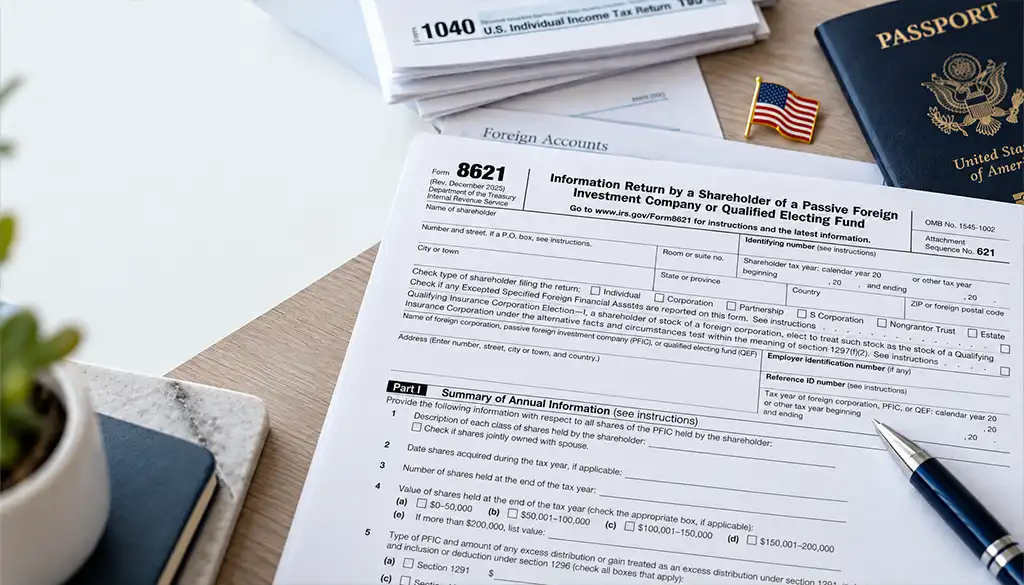
Form 8621, officially called the “Information Return by a Shareholder of a Passive Foreign Investment Company or Qualified Electing Fund,” is used by certain US taxpayers to report interests in Passive Foreign Investment Companies (PFICs). For Americans abroad, this can include foreign mutual funds, investment funds, and other pooled foreign investments that meet the PFIC rules.

Rose-ann De Villa, an IRS Enrolled Agent and CPA with 15 years of expat tax experience, specializes in US tax preparation, tax planning, and tax advice for US citizens and Green Card holders living and working in the UK.
Rose-ann has been mentioned in the Daily Express UK news wherein she talked about Stimulus payments and Child Tax Credit refunds for US expats in the UK. *Schedule a consultation with Rose-ann today.
*30-minutes US$347.
Table of Contents
2026 update: The IRS revised Form 8621 and its instructions in December 2025. For Part V, you may need to enter the three-letter code for the foreign currency used for amounts on lines 15a–15e(1). Any excess distribution reported on line 15e(2) must be shown in US dollars, so foreign-currency amounts need to be converted first.
Do I need to file Form 8621 for my foreign investments?
You may need to file Form 8621 if you directly or indirectly own shares in a Passive Foreign Investment Company (PFIC) and any of the following applies:
- You received certain PFIC distributions.
- You sold or disposed of PFIC shares and recognized a gain.
- You are reporting a Qualified Electing Fund (QEF) election.
- You are using a mark-to-market election.
- You are making certain other PFIC elections.
- You are subject to the annual reporting requirement under Section 1298(f).
There are exceptions to some reporting requirements, including limited exceptions based on the value of certain PFIC holdings, which are explained later.
What are the key requirements to file Form 8621?
Filing Form 8621 involves several requirements that vary depending on your circumstances, including:
- Annual reporting. Form 8621 may need to be filed with your US tax return each year when the annual reporting rules apply.
- Income disclosure. You may need to report PFIC income, distributions, and gains.
- Election details. Some PFIC tax treatments have specific eligibility requirements. A QEF election generally requires annual information from the foreign fund, while the Section 1296 mark-to-market election is generally available only for PFIC stock that qualifies as marketable stock.
- Filing without tax due. Form 8621 can sometimes be required even when there is no current PFIC tax due.
A separate Form 8621 is generally required for each PFIC held directly or indirectly.
How do I identify if my foreign investment should be reported on Form 8621?
Your foreign investment may need to be reported on Form 8621 if it is treated as a Passive Foreign Investment Company (PFIC) under US tax rules.
The investments below are not automatically PFICs, but they may need to be checked to determine whether the PFIC rules apply:
- Foreign mutual funds
- Certain foreign index funds or investment funds
- Hedge funds
- Certain insurance or investment-linked products
- Other pooled investment vehicles based outside the United States
Not every foreign investment is a PFIC. The underlying foreign corporation must meet the PFIC income or asset tests under US tax law.

Still confused about PFIC filing?
We can help you understand more.
What are the criteria for investments to be considered PFICs?
A foreign corporation is generally considered a PFIC if it meets either of the following tests:
- Income test. 75% or more of the corporation’s gross income for the tax year is passive income.
- Asset test. At least 50% of the average value of its assets produces passive income or is held for the production of passive income.
Meeting either test can result in PFIC classification.
What information do I need to report on Form 8621?
To complete Form 8621, you generally need details about the PFIC, your ownership, any distributions or income received, applicable PFIC elections, and any sale or disposal of the investment.
Table 1: Information to gather before completing Form 8621
|
Information needed |
What to gather |
|
PFIC details |
Name, address, and identifying number of the foreign corporation, where applicable |
|
Ownership details |
The shares or other interest you own and information about your ownership |
|
Income and distributions |
PFIC distributions and other relevant income for the tax year |
|
PFIC elections |
Details of any QEF, mark-to-market, or other applicable election |
|
Sales or disposals |
Information needed to calculate gain or loss when PFIC shares are sold or otherwise disposed of |
What information is reported in each part of Form 8621? The part of Form 8621 you complete depends on how the PFIC is treated for US tax purposes and why you are required to file the form.
Table 2: What each part of Form 8621 covers
|
Form 8621 part |
What it covers |
|
Part I |
Summary of annual PFIC information |
|
Part II |
PFIC elections |
|
Part III |
Income from a Qualified Electing Fund (QEF) |
|
Part IV |
Annual income or loss and gains or losses from selling Section 1296 stock under a mark-to-market election |
|
Part V |
Distributions from and dispositions of a Section 1291 fund |
|
Part VI |
Status and termination of certain Section 1294 elections |
You may not need to complete every part of Form 8621. The sections that apply depend on the type of PFIC, any elections in place, and the transaction or reporting requirement that triggered the filing.
Do I need to report minimal PFIC holdings?
Yes, you may still need to report small PFIC holdings. There is no single minimum investment amount that automatically removes all Form 8621 filing requirements.
- When can the US$25,000 or US$50,000 exception apply? For certain Section 1291 funds, you may qualify for an exception from completing Part I if the total value of your relevant PFIC stock is US$25,000 or less, or US$50,000 or less if filing jointly, and you did not receive an excess distribution or recognize a gain from selling or otherwise disposing of that particular fund during the year.
- Is there a separate US$5,000 exception? Yes. A separate US$5,000 Part I exception can apply to certain indirectly owned Section 1291 funds. Your share of the fund must be worth US$5,000 or less at the end of the year, and you must not have received an excess distribution or recognized a gain from selling or otherwise disposing of your interest during the year.
Key Takeaway: The US$25,000 and US$50,000 thresholds apply only to specific Part I exceptions, not to Form 8621 reporting as a whole.
Does Form 8621 reporting differ between individuals and entities?
Yes. Form 8621 can apply to both individuals and US entities, but who must file depends on how the PFIC interest is owned.
- For individuals. US citizens and residents, including Americans living abroad, can have PFIC reporting obligations for direct or indirect PFIC ownership.
- For entities. US corporations, partnerships, trusts, and estates can also have filing requirements when they directly or indirectly own PFIC stock.
Special rules apply where PFIC ownership passes through another entity, so the filing responsibility is not always determined simply by whose name appears on the investment account.
Can I aggregate PFIC investments on a single Form 8621?
Generally, no. A separate Form 8621 is usually required for each PFIC in which you have a direct or indirect interest.
Different PFIC investments generally cannot be combined on one form. Each PFIC is reported separately so its income, distributions, gains, and any applicable elections can be reported correctly.
But, there are two useful distinctions:
- Multiple parts for the same PFIC. One Form 8621 can be used to complete the applicable sections and elections for that same PFIC. You do not need a separate form for each applicable part.
- PFIC jointly owned by spouses. Spouses filing a joint tax return may generally file one Form 8621 for a PFIC they own jointly.
How do I complete and file Form 8621?
Form 8621 is generally filed with your US income tax return. The parts you need to complete depend on the type of PFIC and your circumstances.
The process works like this:
1. Identify the PFIC. Determine whether the foreign investment meets the PFIC rules.
2. Determine why Form 8621 is required. This could be because of annual reporting, a distribution, a sale or disposal, or a PFIC election.
3. Gather your investment information. This may include when you acquired the investment, its value, distributions received, sales, and any previous PFIC elections.
4. Complete the parts that apply. The required sections depend on your situation. For example:
- Section 1291 fund: Part I and, when applicable, Part V
- QEF: Parts I and III, where applicable
- Mark-to-market election: Parts I and IV, where applicable
5. Prepare a separate Form 8621 for each PFIC where required.
6. File Form 8621. Attach it to your US tax return and file by the applicable deadline, including extensions.
If you must file Form 8621 but do not otherwise need to file a US income tax or other return, file Form 8621 directly with the IRS. Check the current instructions for the correct mailing address.
Where can I find help with reporting Form 8621?
The IRS provides detailed instructions for Form 8621, but PFIC reporting can quickly become complicated, particularly when several investments are involved or when QEF, mark-to-market, excess-distribution, or disposal rules apply.
For more complex situations, working with a tax professional experienced in US international taxation and PFIC reporting can help determine which rules apply before the form is prepared.
How long must I keep records about my PFIC reporting?
Keep records supporting your Form 8621 reporting for as long as they may be relevant for US tax purposes.
For PFIC investments, this can include records of:
- when and how you acquired the investment
- your ownership and investment value
- distributions you received
- calculations used for Form 8621
- sales or other disposals
- previously filed Forms 8621
- any PFIC elections you made
The IRS does not set one standard seven-year retention period for Form 8621 records. Instead, records should be kept for as long as their contents may be relevant under US tax law.
Frequently Asked Questions
Do foreign ETFs require Form 8621?
They can. A non-US ETF may be treated as a PFIC if the underlying foreign corporation meets the PFIC income or asset test. This is common enough that Americans investing through foreign brokerage platforms should check the fund’s US tax classification before filing.
Do I still need Form 8938 if I file Form 8621?
Possibly. Filing Form 8621 does not automatically mean you need Form 8938, and it does not remove a Form 8938 requirement if one already applies.
If you are required to file Form 8938, a PFIC already reported on Form 8621 is generally identified in Part IV of Form 8938 rather than reported in full again. However, its value still counts when determining whether you meet the Form 8938 filing threshold.
Does filing Form 8621 mean I do not need to file an FBAR?
No. Form 8621 does not replace the FBAR. If your PFIC is held in a foreign financial account, that account may also need to be reported on FinCEN Form 114 if your combined foreign account balances exceed US$10,000 at any time during the year.
What happens if I forgot to file Form 8621 in a previous year?
A missed Form 8621 can affect how long the IRS has to assess tax for that year. The correct way to address it depends on the year involved, the PFIC activity, and whether an election or other reporting requirement was missed. Prior-year PFIC issues are best reviewed before simply filing the missing form.
Are PFIC investments inside a foreign pension always reported on Form 8621?
Not always. Certain treaty-covered foreign pension arrangements may qualify for an exception from the Part I annual reporting requirement in specific situations.
However, this does not automatically remove all Form 8621 requirements. Other PFIC reporting rules may still apply depending on the pension, the investments held, and what happened during the tax year